How to Set Up Solar Power in Your Caravan — A Complete Guide
Affiliate Disclosure: This post contains affiliate links. If you purchase through our links we may earn a small commission at no extra cost to you. We only recommend products we genuinely believe in.
Solar power is the single most liberating upgrade you can make to your caravan — and for Australian grey nomads, it is almost essential. The freedom to pull up anywhere in Australia, knowing you have reliable, free power from the sun regardless of whether a powered site is nearby, changes everything about how you travel. No more limiting your itinerary to caravan parks. No more paying $50-80 per night for a powered site when a beautiful free camp is just down the road. No more rationing your fridge or worrying about flat batteries. Here is a complete guide to setting up solar power in your caravan — everything you need to know, from how much power you actually need to the best products available in Australia.
Why Solar Power Is Essential for Grey Nomads
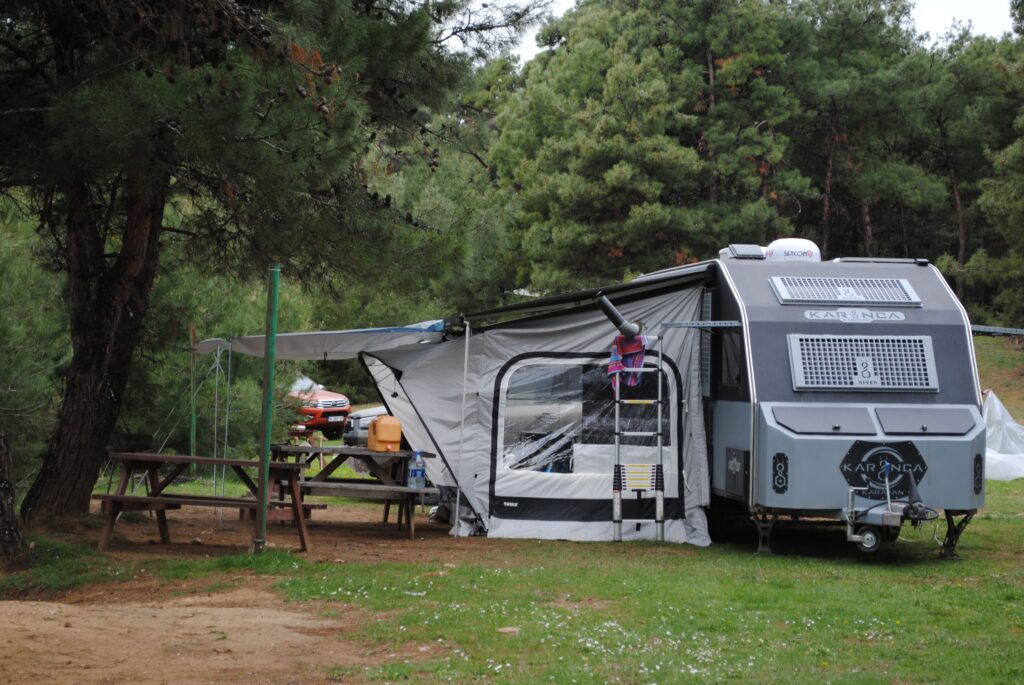
Freedom to free camp anywhere The single greatest benefit of a quality caravan solar setup is the freedom it delivers — the ability to park up at any free camp in Australia and stay as long as you want, powered entirely by the sun. Australia has thousands of extraordinary free camping spots — from remote outback gorges to beautiful coastal locations — that are simply not accessible to caravanners without self-sufficient power.
No more powered site fees A quality solar setup pays for itself relatively quickly when you consider the cost of powered sites — typically $40-80 per night at commercial caravan parks. A grey nomad spending 200 nights per year on the road and avoiding powered sites saves $8,000-16,000 per year in site fees alone.
Australian sunshine is extraordinary Australia receives some of the highest solar radiation levels in the world — making it genuinely one of the best countries on earth for solar power. Even in winter — when days are shorter — Australia’s sunshine delivers reliable solar charging throughout the year.
Quiet, clean, maintenance free Solar power produces no noise, no fumes, and requires virtually no maintenance — unlike generators, which require fuel, produce exhaust fumes, and disturb the peace of remote camping locations.
Environmentally responsible For grey nomads who love Australia’s extraordinary natural environments — travelling on solar power is the most environmentally responsible way to explore and enjoy the country.
How Much Solar Do You Actually Need?
Before purchasing any solar equipment — the most important question is how much power you actually need. Getting this right prevents both underpowering your setup (running out of power) and overspending on more capacity than you need.
Step 1 — Calculate your daily power consumption:
The most power-hungry item in most caravans is the 12V compressor fridge — typically consuming 30-60Ah per day depending on size and ambient temperature. Everything else adds up from there.
Typical grey nomad daily power consumption:
| Item | Daily consumption |
|---|---|
| 12V compressor fridge (60L) | 30-50Ah |
| LED lighting | 5-10Ah |
| Phone and device charging | 5-10Ah |
| Water pump | 2-5Ah |
| Fan | 5-15Ah |
| Laptop | 10-20Ah |
| Total typical daily use | 57-110Ah |
Step 2 — The rule of thumb:
A quality solar setup should be able to replace your daily consumption with a reasonable safety margin. As a general rule:
- For a basic setup — 200W of solar panels and 100Ah of battery storage is a minimum starting point for most couples
- For a comfortable setup — 400W of solar panels and 200Ah of battery storage covers most grey nomad needs comfortably
- For an extended off-grid setup — 600W+ of solar panels and 300Ah+ of battery storage allows extended stays in low-sun conditions
Step 3 — Account for Australian conditions:
In most parts of Australia — you can expect 4-6 peak sun hours per day for solar charging. A 200W panel in 5 peak sun hours generates approximately 1,000Wh or 83Ah of power per day — enough to cover most basic setups.
The Two Types of Solar Panels
Portable and Foldable Solar Panels
Portable solar panels are foldable units that can be set up on the ground away from the caravan — allowing you to position them for maximum sun exposure regardless of which direction your caravan is facing.
Advantages of portable solar panels:
- Can be angled and positioned for maximum efficiency
- Easy to set up and pack away
- No permanent installation required
- Can be used with multiple vehicles or setups
- Ideal for caravanners who want flexibility
Best for: Caravanners who move frequently, those wanting flexibility, or those adding solar to an existing setup without roof modifications.
Check out Renogy’s portable solar panel range 👇 https://renogy.sjv.io/aN6nDq
Also check out our recommended portable solar panel on Amazon 👇 https://link.amazon/B07DHmQNB
Rooftop Fixed Solar Panels
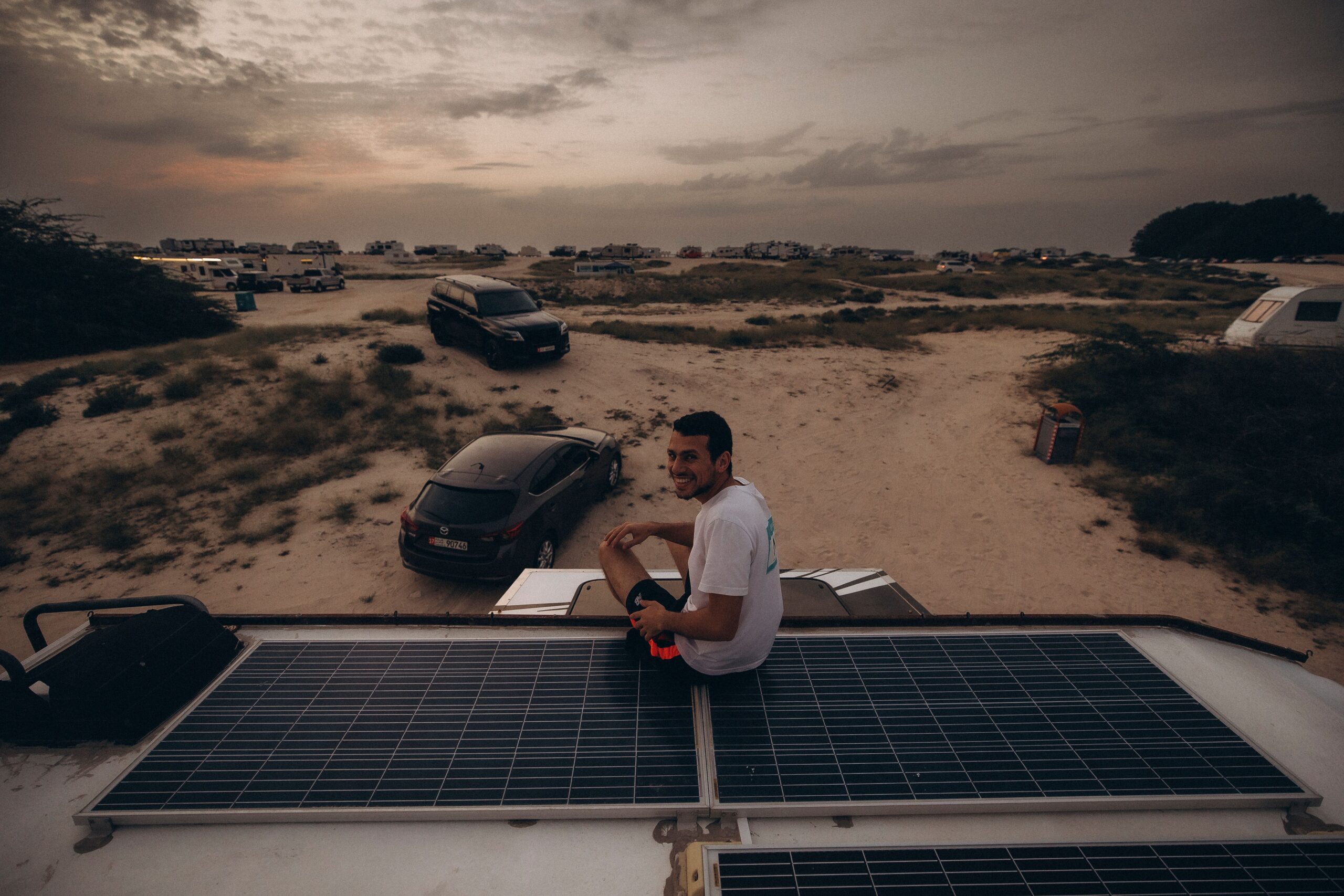
Rooftop solar panels are permanently mounted on the caravan roof — always in position, always charging whenever the sun is out, with no setup or pack-down required.
Advantages of rooftop solar panels:
- Always charging — no setup required
- Cleaner installation — wiring hidden
- Higher total capacity possible
- No risk of forgetting to set up or pack away
- Best for extended off-grid travel
The honest consideration: Rooftop panels are fixed in whatever direction your caravan is facing — if you park in shade or facing away from the sun, output is reduced. Many serious grey nomads combine rooftop panels with a portable panel for maximum flexibility.
Best for: Full-time grey nomads, extended off-grid travel, caravanners who want a permanent self-sufficient setup.
Check out Renogy’s solar panel range 👇 https://renogy.sjv.io/NGPkEP
The Best Renogy Solar Products for Grey Nomads
Renogy is one of the world’s most trusted solar brands — with a comprehensive range of products specifically suited to caravan and off-grid solar setups. All prices are indicative and subject to change.
Portable Solar Panels: Perfect for grey nomads who want flexibility — foldable, lightweight, and easy to set up anywhere.
Check out Renogy portable solar panels 👇 https://renogy.sjv.io/aN6nDq
Solar Panel Kits: Complete solar kit systems that include everything needed to get started — panels, charge controller, cables, and mounting hardware. The most practical option for caravanners setting up solar for the first time.
Check out Renogy solar panel kits 👇 https://renogy.sjv.io/jR2rab
Lithium Batteries: Renogy’s lithium iron phosphate (LiFePO4) batteries are among the best available for caravan solar setups — lightweight, long-lasting, and capable of deeper discharge cycles than AGM batteries.
Check out Renogy batteries 👇 https://renogy.sjv.io/k4b0Ax
Browse the full Renogy range 👇 https://renogy.sjv.io/2RY17M
Batteries — The Heart of Your Solar System
Solar panels generate power when the sun shines — but your battery bank is what stores that power for use at night, on cloudy days, and whenever the panels aren’t generating.
Lithium vs AGM — The Honest Comparison
| Feature | Lithium (LiFePO4) | AGM |
|---|---|---|
| Weight | Significantly lighter | Heavy |
| Usable capacity | 80-100% of rated capacity | 50% of rated capacity |
| Cycle life | 2,000-5,000 cycles | 300-500 cycles |
| Charge speed | Fast | Slow |
| Cost | Higher upfront | Lower upfront |
| Long term value | Excellent | Poor |
The honest recommendation: Lithium batteries cost more upfront but are significantly better value over the long term — lighter, longer-lasting, and more usable capacity per kilogram. For serious grey nomads planning extended travel — lithium is the right choice.
Check out Renogy lithium batteries 👇 https://renogy.sjv.io/k4b0Ax
How much battery storage do you need:
| Setup | Recommended battery capacity |
|---|---|
| Basic — fridge, lights, devices | 100Ah lithium |
| Comfortable — above plus fan, laptop | 200Ah lithium |
| Extended off-grid | 300Ah+ lithium |
How to Set Up a Basic Solar System — Step by Step
A basic caravan solar system consists of four components — solar panels, a charge controller, a battery bank, and wiring connecting everything together.
The four components:
1. Solar panels — generate DC power from sunlight
2. Charge controller — regulates the power flowing from the panels to the battery, preventing overcharging and damage. A quality MPPT charge controller is strongly recommended — more efficient than PWM controllers, particularly in variable light conditions.
3. Battery bank — stores the power generated by the panels for use when the sun isn’t shining
4. Inverter (optional) — converts DC battery power to 240V AC power for running standard appliances. Not necessary if you are running 12V appliances only.
The basic wiring sequence: Solar panels → Charge controller → Battery bank → 12V distribution/fuse box → Appliances
The honest recommendation: Unless you are confident with 12V electrical systems — have your solar system installed by a qualified auto electrician. Incorrect wiring can damage expensive equipment and create fire risks.
Practical Tips for Grey Nomads
Position panels for maximum sun exposure The sun tracks across the northern sky in Australia — positioning your panels facing north and angled toward the sun maximises output. Many grey nomads park their caravan with the roof panels facing north as a matter of habit.
Monitor your system A battery monitor — a simple gauge that shows your battery state of charge, current draw, and charge rate — is one of the best investments you can make in your solar setup. Knowing exactly how much power you have and how fast you’re using it prevents nasty surprises.
Manage power on cloudy days In extended cloudy weather — even a quality solar setup will struggle to fully recharge your batteries. Having a backup charging option — either a generator, a DC-DC charger from your tow vehicle, or simply driving for a few hours — is good contingency planning for extended overcast periods.
Common mistakes to avoid:
- Undersizing the battery bank — the most common mistake. More battery storage is almost always better.
- Cheap charge controllers — a quality MPPT charge controller makes a significant difference to system efficiency
- Ignoring cable sizing — undersized cables create resistance, heat, and power loss. Always use correctly sized cables for your system’s current draw.
- Not fusing properly — always fuse at the battery and at appropriate points throughout the system
The Complete Solar Setup Shopping Guide
Everything you need for your caravan solar setup:
| Product | Link |
|---|---|
| Renogy portable solar panels | Shop here |
| Renogy solar panel kits | Shop here |
| Renogy lithium batteries | Shop here |
| Renogy full range | Shop here |
| Portable solar panel — Amazon | Shop here |
| Portable fridge freezer — Amazon | Shop here |
Have you set up solar power in your caravan? Share your setup and tips in The Good Years Club community — your experience could help another grey nomad plan the perfect off-grid system 💙
👉 Join The Good Years Club Community — https://www.facebook.com/share/g/1Fw4FHNpJr/