The Best Music Activities for Seniors in Aged Care — A Guide for Carers and Activity Professionals
Of all the tools available to aged care workers and activity professionals there is none more powerful than music. The research is extraordinary. The results are immediate and visible. And the moments of genuine human connection that music creates — particularly for residents living with dementia — are among the most profound experiences this work offers. Here is a complete practical guide to the best music activities for seniors in aged care — written by someone who has witnessed the transformative power of music in aged care firsthand.
Why Music Works — The Science Behind It
Before exploring specific activities it’s worth understanding why music is so extraordinarily powerful for older adults — and particularly for those living with dementia.
Musical memory is stored differently in the brain to other types of memory. While dementia progressively damages the hippocampus — the brain region most associated with forming new memories — the areas that store musical memory are often remarkably preserved even in advanced dementia.
This means that songs from a person’s youth — particularly from their teens and twenties — can unlock memories, emotions, and moments of genuine recognition long after other memories have faded. A resident who cannot remember what they had for breakfast may sing along word perfect to a song from 1962.
What the research shows:
Music therapy and music based interventions in aged care have been shown to:
- Significantly reduce agitation and anxiety in residents with dementia
- Improve mood and emotional wellbeing
- Reduce the need for sedating medications in some residents
- Stimulate autobiographical memory and communication
- Improve social engagement and connection
- Reduce pain perception
- Improve quality of life across multiple measures
Music is not just entertainment in aged care. It is therapy.
The Foundation — Building a Music History for Every Resident
Before implementing any music activity the single most important step is understanding each resident’s individual music history.
Music is deeply personal — a song that creates joy and connection for one resident may create distress or indifference for another. The power of music in aged care comes from its personal relevance — not from music in general but from this person’s music.
How to gather music history information:
- Ask families to complete a music history as part of the admission process — favourite artists, favourite songs, music associated with significant life events
- Ask residents directly — particularly in early stages of dementia when they can still communicate preferences
- Observe responses during group music activities — who lights up at what
- Review life history information — a person who loved dancing in the 1960s almost certainly has strong connections to the music of that era
What to document:
- Favourite artists and genres
- Era of music most meaningful to them — usually teens and twenties
- Songs associated with significant memories — wedding song, songs from childhood
- Music they disliked or that creates negative associations
- Instruments they played or were associated with
As I explored in how to connect with residents who have dementia — knowing a resident’s story is the foundation of everything in dementia care. Their music history is one of the most important chapters of that story.
Activity 1 — Personalised Playlist Program
What it is: Creating individual personalised playlists for residents — particularly those with dementia — that can be played through headphones or a small speaker during personal care, rest periods, or times of agitation.
Why it works: Personalised playlists provide the maximum benefit of music therapy because they’re built entirely around the individual’s specific music history. The Music and Memory program — an internationally recognised initiative — has demonstrated remarkable results with personalised playlists in aged care settings worldwide.
How to implement it:
- Gather music history information for each resident
- Create playlists of 10 to 20 songs from their most meaningful era
- Load playlists onto a tablet, phone, or dedicated music player
- Use headphones for individual listening — particularly during personal care or at times of agitation
- Document responses — which songs create positive responses, which create distress
- Refine playlists based on observed responses
- Share playlist information with families so they can continue at home
Practical tips:
- Headphones significantly enhance the experience — they block out facility noise and create an intimate personal connection with the music
- Start quietly and increase volume gradually
- Sit with the resident for the first few sessions to observe and document responses
- Share the playlist with family members — they can use it during visits
Activity 2 — Group Singalong Sessions
What it is: Facilitated group singing sessions — typically 30 to 45 minutes — built around songs familiar to the resident group.
Why it works: Singing activates multiple brain regions simultaneously — including areas that store memory, language, and emotion. Group singing adds a social dimension that enhances the benefits further. Many residents who rarely speak in other contexts will sing in a group singalong.
How to run an effective singalong:
Choose the right repertoire Build your song list around the era most relevant to your residents — for most current Australian aged care residents this means the 1940s through to the 1970s. Australian favourites, popular standards, folk songs, and hymns for those with religious backgrounds all work well.
Songs that consistently work well:
- You Are My Sunshine
- Pack Up Your Troubles
- It’s a Long Way to Tipperary
- Waltzing Matilda
- Click Go the Shears
- My Favourite Things
- Moon River
- Beyond the Sea
- Elvis favourites — Jailhouse Rock, Love Me Tender
- Beatles classics — Hey Jude, Let It Be
Facilitation tips:
- Use large print song sheets — the words give residents confidence to participate
- Sit in a circle or semicircle so residents can see each other
- Make eye contact with individual residents — particularly those who seem hesitant
- Start with familiar high energy songs to warm up the group
- Include slower more reflective songs in the middle
- End on a high energy positive note
- Never make anyone feel pressured to participate — invitation not obligation
For residents with dementia: Don’t be discouraged if participation seems minimal initially. Residents with dementia may not appear engaged but are often processing and benefiting even when they seem distant. Watch for foot tapping, hand movements, facial expressions — these are signs of engagement even when verbal participation is absent.
Activity 3 — Music and Movement
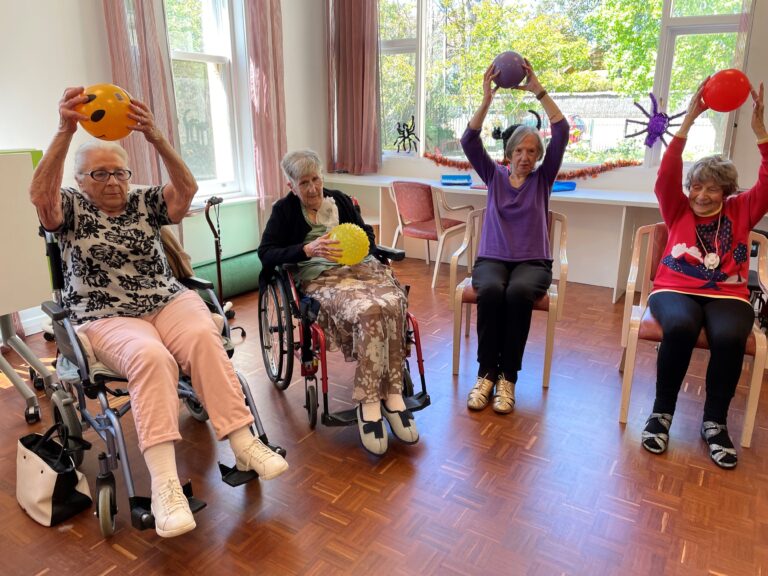
What it is: Combining music with gentle movement — clapping, chair dancing, conducting, using simple percussion instruments — to create a multisensory activity that engages the body as well as the mind.
Why it works: Adding movement to music activates additional brain regions and provides gentle physical exercise simultaneously. For residents with limited mobility chair based movement to music provides physical stimulation that is otherwise difficult to achieve.
How to implement it:
Simple instruments: Provide simple percussion instruments — maracas, tambourines, rhythm sticks, bells — that residents can play along with recorded or live music. These are inexpensive, easy to use, and create a sense of active participation rather than passive listening.
Chair dancing: Facilitate gentle upper body movement to upbeat music — arm movements, clapping, swaying. For residents with better mobility standing or walking to music can be incorporated safely.
Conducting: Give residents a baton — or simply their hand — and invite them to conduct the music. This simple activity creates a surprising sense of agency and engagement and is particularly effective with residents who were involved with music or dance in their lives.
Scarf dancing: Provide lightweight colourful scarves for residents to wave and move with music. Simple, joyful, and suitable for almost any level of physical ability.
Activity 4 — Live Music Sessions
What it is: Live musical performances in the facility — by professional musicians, volunteer performers, staff, families, or school groups.
Why it works: Live music creates an energy and presence that recorded music cannot replicate. The social dimension of a live performer — someone making music specifically for the residents in front of them — creates a quality of engagement and connection that is unique.
How to organise live music:
Professional musicians: Many musicians specifically perform in aged care settings. Local music schools, community orchestras, and professional entertainers who specialise in aged care music are all worth approaching.
Volunteer performers: Local schools, choirs, community groups, and amateur musicians often welcome opportunities to perform in aged care facilities. A request through local community Facebook groups, schools, or community centres often generates more responses than expected.
Intergenerational music: Performances by children — school choirs, student musicians — create particularly powerful responses in aged care residents. The combination of live music and intergenerational connection amplifies the benefit of both.
Staff and family performances: Don’t overlook the musical talents within your own community. A staff member who plays guitar, a family member who sings — informal performances by people the residents know can be among the most meaningful.
Activity 5 — Music and Reminiscence
What it is: Using music as a trigger for structured reminiscence conversations — playing songs from a specific era and facilitating discussion of the memories, emotions, and stories they evoke.
Why it works: Music is one of the most powerful triggers for autobiographical memory available. Songs from a person’s youth are deeply associated with specific memories — where they were, who they were with, what they were feeling. Using music to open reminiscence conversations accesses memories that might not be reachable through direct questioning.
How to facilitate a music reminiscence session:
- Choose a theme — a decade, a season, a life event — and select 4 to 6 songs associated with that theme
- Play each song for 1 to 2 minutes
- Pause and open discussion — “Does anyone remember where they were when this song was popular?” “What does this song remind you of?” “Did anyone dance to this?”
- Listen actively and follow the conversation where residents take it
- Document memorable stories and share with families
Questions that work well:
- Where were you when this song was popular?
- Did you dance to this? Where?
- Is there a person this song reminds you of?
- What was happening in your life when this was on the radio?
As I wrote in the best music of the 50s and 60s — the music of that era is the soundtrack of most current aged care residents’ most formative years. It is an extraordinarily rich source of reminiscence material.
Activity 6 — Musical Life Story
What it is: A structured activity that helps residents create a personal musical autobiography — a collection of songs that represent the chapters of their life — which becomes both a therapeutic activity and a lasting legacy document.
Why it works: The process of identifying and discussing the songs of their life is deeply meaningful for residents — it affirms their identity, validates their history, and creates something tangible that families treasure. For residents with dementia it provides a structured way to access and express autobiographical memory.
How to implement it:
- Work with the resident one on one or in a small group
- Guide them through the chapters of their life — childhood, teenage years, young adulthood, marriage, parenthood, significant events
- Ask which songs they associate with each chapter
- Document the songs and the stories behind them
- Create a personalised playlist that represents their musical life story
- Share with families — the document and the playlist
This activity connects beautifully to the life story work I described in how to connect with residents who have dementia — music and life story are two of the most powerful tools in dementia care and combining them creates something extraordinary.
Practical Tips for All Music Activities
Volume matters Music that is too loud creates agitation rather than calm — particularly for residents with dementia or sensory sensitivities. Start at a moderate volume and adjust based on the group’s response.
Timing matters Music activities tend to work best in the morning or early afternoon when residents are most alert and engaged. Late afternoon and evening — when sundowning is common in dementia — can be a good time for calm soothing music but is generally not ideal for active music activities.
Observe and document Document resident responses to music activities carefully — which activities created positive responses, which songs created engagement or distress, which residents benefited most. This information improves future activities and provides valuable clinical data.
Involve families Share music activity information with families — the songs their loved one responded to, the memories that surfaced, the moments of connection. Families treasure this information and it strengthens their relationship with the facility.
Don’t force participation Invitation not obligation. A resident who doesn’t want to participate should never feel pressured. Often the most resistant residents become the most engaged participants once they feel safe — but only if their initial reluctance is respected.
Resources for Music in Aged Care
Music and Memory musicandmemory.org — the internationally recognised personalised music program with extraordinary evidence behind it. Training and certification available for aged care facilities.
Australian Music Therapy Association austmta.org.au — information about registered music therapists in Australia who can provide clinical music therapy services in aged care settings.
Dementia Australia dementia.org.au — 1800 100 500 — resources on music and dementia care.
The Bottom Line
Music is not a nice to have in aged care. It is a clinical intervention with an extraordinary evidence base — accessible, affordable, and available to every facility regardless of resources.
A personalised playlist. A weekly singalong. A live performance. A music reminiscence session.
Any of these — done consistently and with genuine attention to the individual — can transform a resident’s quality of life.
Start with one. Do it well. Then build from there.
Are you an activity professional or carer using music in aged care? Come and share your experience in The Good Years Club community — and join our growing network of aged care professionals across Australia 💙
👉 Join The Good Years Club Community — https://www.facebook.com/share/g/1Fw4FHNpJr/