The Best Portable Solar Panels for Grey Nomads — A Complete Guide
For grey nomads who want the freedom to camp anywhere in Australia — not just at powered caravan park sites — a quality portable solar panel setup is one of the most liberating investments available. Solar power means staying at a stunning free camp for as long as you want, running your fridge, charging your devices, and living comfortably off-grid without being tethered to a power outlet. Here’s a complete guide to the best portable solar panels for grey nomads and caravanners in Australia.
Why Portable Solar Is Worth the Investment
The freedom factor With adequate solar power, the entire map of Australia opens up. Free camps, remote gorges, beachfront spots miles from the nearest town — none of it requires a powered site when your solar setup can run your essential appliances indefinitely in good sunlight.
The cost savings Caravan park powered sites typically cost $35-70 per night. For a grey nomad spending three to six months on the road, replacing even a third of those paid nights with free camping powered by solar represents thousands of dollars in savings over the course of a trip.
The environmental benefit Running your caravan off solar rather than a generator eliminates noise, fuel costs, and emissions — making for a more peaceful camp experience for you and your neighbours.
The practical reality A well-designed solar setup running a quality compressor fridge — as I wrote in the best portable fridges for caravanning in Australia — is the foundation of genuine off-grid capability. The two work together — solar generates the power, the fridge is typically the primary ongoing power draw.
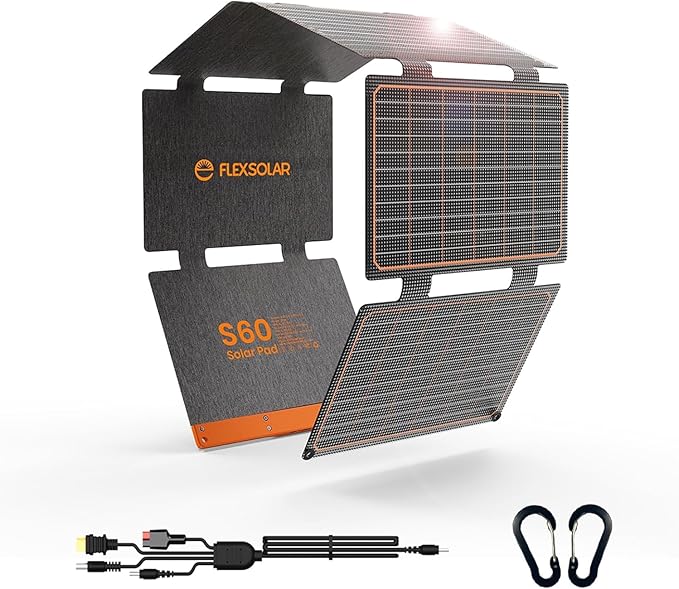
Ready to invest in solar for your caravan? Check out our recommended portable solar panel here 👇 https://link.amazon/B07DHmQNB
Understanding Solar — The Key Concepts Worth Knowing
Before looking at specific panels, understanding a few key concepts makes the buying decision significantly easier.
Watts and watt-hours A solar panel’s wattage — 100W, 200W, 300W — describes how much power it can generate at peak output in ideal conditions. Watt-hours describe how much energy is actually generated over time — a 200W panel in good Australian sunlight for five hours generates roughly 1,000Wh (1kWh) of energy, accounting for real-world efficiency losses.
The honest caveat on panel ratings: Panel wattage ratings are measured under ideal laboratory conditions — direct perpendicular sunlight at a specific temperature. Real-world output is typically 70-80% of the rated figure, depending on the angle of the sun, cloud cover, panel temperature, and wiring efficiency.
Amps and amp-hours Your battery bank is measured in amp-hours (Ah) — the amount of current it can deliver over time. A 100Ah battery can theoretically deliver 10 amps for 10 hours. In practice, quality lithium batteries should be discharged to no more than 80% of capacity — a 100Ah lithium battery has an effective usable capacity of around 80Ah.
Matching solar to consumption The practical question is whether your solar generation covers your daily power consumption. A typical grey nomad setup running a 45-60 litre compressor fridge, LED lighting, phone and device charging, and occasional laptop use typically consumes 40-60Ah per day. A 200W solar panel in good Australian sunlight generates 60-80Ah per day — a reasonable match for most setups.
Portable vs Fixed Rooftop Solar — Which Is Right for You?
Fixed rooftop solar panels Permanently mounted to the roof of the caravan — generating power continuously whenever there is sunlight without any setup required. The disadvantage is that they generate power based on the angle and direction the caravan is parked, regardless of whether that’s optimal for solar generation.
Portable solar panels Can be positioned and angled independently of where the caravan is parked — allowing you to face the panel directly at the sun throughout the day for maximum generation, even when the caravan is parked in shade.
The honest recommendation for most grey nomads: A combination of fixed rooftop solar for continuous background generation and a portable panel for supplementing on cloudy days or when parked in sub-optimal positions is the most flexible approach. For those with limited roof space or who want to start simple — a quality portable panel alone is a perfectly practical starting point.
What to Look for When Choosing a Portable Solar Panel
Wattage — How Much Do You Actually Need?
For a basic setup — single traveller or weekend camping: A 100-120W portable panel provides sufficient power for basic needs — phone and device charging, LED lighting, and minimal appliance use. Not sufficient to run a compressor fridge reliably on its own.
For a couple’s setup — extended touring: A 200W portable panel is the most practical choice for most travelling couples — sufficient to run a 45-60 litre compressor fridge alongside device charging and LED lighting in good sunlight conditions.
For a serious off-grid setup: 200W+ — either a single large panel or two smaller panels connected in parallel — provides genuine off-grid capability for couples running a fridge, devices, laptop, and occasional higher-draw appliances.
Panel Type — Monocrystalline vs Polycrystalline
Monocrystalline panels Made from a single crystal of silicon — more efficient, perform better in low light and high temperatures, and are more compact for the same wattage. The clear choice for Australian conditions where high temperatures and variable light are the reality.
Polycrystalline panels Made from multiple silicon fragments — slightly less efficient and less effective in high temperatures. Generally cheaper but less suited to the demands of Australian outback conditions.
The recommendation: Monocrystalline panels are worth the modest additional cost for Australian caravanning conditions.
Durability and Build Quality
Australian outback conditions are genuinely demanding — portable solar panels need to handle dust, vibration, UV exposure, and the general rough and tumble of life on the road.
What to look for:
- Tempered glass or quality ETFE laminate surface — both handle Australian UV and physical wear well
- Robust frame construction — aluminium frames withstand the vibrations of corrugated roads better than plastic
- Quality MC4 connectors — the industry standard connector type, compatible with most charge controllers and solar accessories
- IP rating — a higher IP rating indicates better dust and water resistance, important for Australian conditions
Folding vs Rigid Panels
Folding solar blankets and suitcase panels Compact when folded, easy to store, and simple to deploy and angle at camp. The most popular choice for grey nomads who want portability and flexibility. Quality varies significantly between budget and premium options.
Rigid portable panels Heavier and bulkier than folding options but often more durable and more efficient for the same wattage. Better suited to semi-permanent setups where the panel doesn’t need to be packed away frequently.
Charge Controller Compatibility
A solar panel doesn’t connect directly to your battery — it connects via a charge controller that manages the charging process and protects the battery from overcharging.
The two main types:
- PWM (Pulse Width Modulation) — the older, simpler, and cheaper technology. Functional but significantly less efficient than MPPT, particularly when panel voltage is significantly higher than battery voltage.
- MPPT (Maximum Power Point Tracking) — more sophisticated and significantly more efficient — typically converting 10-30% more of your panel’s output into usable battery charge compared to PWM. Worth the additional cost for any serious off-grid setup.
The practical recommendation: If you’re investing in quality solar panels, pair them with a quality MPPT charge controller — the improved efficiency meaningfully increases the effective output of your panels.
Want to skip the research and go straight to a quality option? Here’s our top pick 👇 https://link.amazon/B07DHmQNB
The Best Portable Solar Panels for Australian Grey Nomads
Budget Option — Under $200
For travellers on a tighter budget or those wanting to test solar before committing to a larger setup, several quality folding solar panels are available under $200 that deliver reliable performance for Australian conditions.
What to look for in this price range: Monocrystalline cells, MC4 connectors, a folding suitcase design for easy transport, and basic IP weather resistance. Build quality and longevity may not match premium options — but for occasional use or as a supplementary panel alongside rooftop solar, a budget portable panel is a practical starting point.
Best for: Weekend campers, those supplementing existing rooftop solar, or budget-conscious travellers wanting to try solar before upgrading.
Mid-Range Option — $200-$500
The mid-range is where the best value for most grey nomads sits — quality monocrystalline cells, good build quality, and adequate features for extended Australian touring without the premium brand price.
What to look for in this price range: High-efficiency monocrystalline cells, robust aluminium frame or quality flexible construction, MC4 connectors, IP65 or better weather resistance, and a folding or rollable design that stores compactly.
Best for: Regular grey nomads doing extended trips who want reliable solar performance without paying premium brand prices.
Premium Option — $500+
Premium portable solar panels from brands like Renogy, Enerdrive, Redarc, and Goal Zero represent the top tier of the market — offering the highest efficiency cells, exceptional build quality, and the reliability that comes from proven brands with strong Australian after-sales support.
What to look for in this price range: Tier 1 monocrystalline cells with efficiency ratings of 22%+, exceptional build quality suited to years of demanding Australian conditions, comprehensive warranty support, and compatibility with quality MPPT charge controllers.
The honest case for premium: For full-time or near full-time grey nomads doing the Big Lap or extended outback travel — a premium portable solar panel paired with a quality MPPT charge controller and lithium battery bank is a genuinely worthwhile investment. The combination of superior efficiency, exceptional durability, and strong warranty support means the total cost of ownership over time often makes the premium price worthwhile.
Best for: Full-time grey nomads, serious off-grid travellers, or anyone who wants to buy once and build a genuinely reliable off-grid power system.
Building a Complete Off-Grid Power System
A portable solar panel is one component of a complete off-grid power system — understanding how the components work together helps you make better decisions about each one.
The four components of a complete system:
1. Solar panels Generate DC electricity from sunlight — your portable panel or combination of portable and rooftop fixed panels.
2. Charge controller Manages the flow of electricity from the panels to the battery — protecting the battery from overcharging and optimising the charging process. As discussed above — MPPT is worth the additional cost.
3. Battery bank Stores the electricity generated by your panels for use when the sun isn’t shining. Lithium batteries — specifically LiFePO4 chemistry — have become the clear choice for serious grey nomads, offering significantly more usable capacity, longer cycle life, faster charging, and lighter weight than equivalent AGM lead-acid batteries.
4. Inverter (if needed) Converts DC battery power to 240V AC for running standard appliances. Not all setups need an inverter — many caravan appliances run directly from 12V DC — but a quality inverter is needed for laptops, some kitchen appliances, and other 240V devices.
Practical Tips for Getting the Most Out of Your Portable Solar Panel
Angle the panel toward the sun The single most impactful thing you can do to maximise solar output is angle the panel perpendicular to the sun throughout the day. A panel lying flat on the ground generates significantly less power than one angled directly at the sun — particularly in winter when the sun is lower in the sky.
Keep the panel cool Solar panel output decreases as panel temperature increases — a panel in direct contact with hot ground or enclosed in a hot space generates less power than one with airflow underneath it. Elevating the panel slightly on its legs or frame improves output in hot conditions.
Keep the panel clean Dust accumulation significantly reduces panel output — a dusty panel can lose 20-30% of its rated output. A quick wipe with a damp cloth before setting up in dusty outback conditions makes a meaningful difference.
Use quality cabling Undersized or low-quality cables between the panel and charge controller create resistance that reduces the power reaching your battery. Use appropriately sized cables for the current your system carries.
Monitor your system A battery monitor — installed between your battery and your loads — gives you a real-time picture of your battery state of charge, current draw, and solar input. Essential for understanding how your system is performing and for avoiding inadvertently running your battery too flat.
The Bottom Line
A quality portable solar panel is one of the best investments a grey nomad can make — unlocking the ability to free camp almost anywhere in Australia with the comfort of a powered campsite.
The right choice depends on your power consumption, your budget, and how seriously you want to pursue off-grid living. But for most travelling couples doing extended Australian touring — a 200W monocrystalline portable panel paired with a quality MPPT charge controller and a 100Ah+ lithium battery bank represents the sweet spot of performance, value, and genuine off-grid capability.
Start with what you can afford. Learn how your system performs. And upgrade as your confidence and ambition grows.
Check out our recommended portable solar panel here 👇 https://link.amazon/B07DHmQNB
What solar setup are you running in your caravan? Share your experience in The Good Years Club community — your knowledge could help another grey nomad get their system right 💙
👉 Join The Good Years Club Community — https://www.facebook.com/share/g/1Fw4FHNpJr/