The Best Hikes and Walks in Australia for Seniors
Australia has some extraordinary places to explore on foot.
And you do not need to climb mountains or walk 20 kilometres a day to enjoy them.
There are coastal paths, rainforest walks, desert landscapes and national park trails suitable for everything from relaxed morning walks to challenging full day adventures.
The key after 60 is not necessarily choosing the easiest walk.
It is choosing a walk that suits your current fitness, mobility, experience and confidence.
Here are some of the best hikes and walks around Australia to consider.
Choosing the Right Walk for You
Australia uses a walking track grading system that generally runs from Grade 1 through to Grade 5.
At the easier end are accessible, well formed paths.
As the grade increases, you can expect things such as longer distances, steeper sections, rougher terrain, navigation challenges and greater physical demands.
Do not choose a walk simply because someone else your age completed it.
Look at:
Distance
Elevation
Track grade
Steps
Terrain
Weather
Water availability
Toilets and facilities
Mobile reception
How long the walk is expected to take
If you are returning to walking after a long break, start with something comfortably within your ability and build from there.
Noosa Coastal Walk, Queensland
Noosa National Park offers one of Queensland’s most enjoyable coastal walking areas.
The Coastal Walk passes beaches, headlands and coastal bushland with plenty of opportunities to turn around before completing the entire route.
That flexibility makes it particularly useful if you are unsure how far you want to walk.
Distance: Up to approximately 10 kilometres return depending on your route
Difficulty: Moderate in sections
Why we like it: You can enjoy a short coastal walk without committing to the entire track.
Queensland heat and humidity can make a significant difference, so check conditions and consider walking earlier in the day during warmer weather.
Bondi to Coogee Coastal Walk, New South Wales
This is one of Australia’s most famous urban coastal walks.
The route passes beaches, cliffs, parks and ocean pools between Bondi and Coogee.
Distance: Approximately 6 kilometres one way
Difficulty: Moderate, with steps and inclines
Why we like it: There are plenty of places to stop, and you are never particularly far from facilities, food or transport.
You also do not have to walk the entire route.
Walking one section and stopping for coffee can be every bit as enjoyable.
Spit Bridge to Manly Walk, New South Wales
For something that feels more like bushwalking while remaining close to Sydney, the Spit to Manly route is worth considering.
The track combines harbour views, bushland and beaches.
Distance: Approximately 10 kilometres one way
Difficulty: Moderate
Why we like it: Beautiful scenery without needing to travel far from Sydney.
There are steps and uneven sections, so do not mistake its urban location for an entirely easy walk.
Uluru Base Walk, Northern Territory
Walking around the base of Uluru offers a completely different experience from Australia’s coastal trails.
The full circuit provides an opportunity to experience the landscape from ground level while learning more about its enormous cultural significance.
Distance: Approximately 10.6 kilometres
Difficulty: Relatively flat, but the distance and heat still matter
Why we like it: An extraordinary landscape and cultural experience without steep climbing.
Heat is the major consideration here.
Check current conditions and Parks Australia advice before setting out, carry adequate water and respect all signs relating to culturally sensitive areas.
Valley of the Winds, Northern Territory
The Valley of the Winds at Kata Tjuta is considerably more demanding.
The full circuit travels through an extraordinary desert landscape between the domes.
Distance: Approximately 7.4 kilometres for the complete circuit
Difficulty: Challenging
Why we like it: One of the most memorable walking landscapes in Central Australia.
This is not a walk I would describe as suitable for most seniors.
It is better suited to experienced and physically capable walkers who are comfortable with the distance, terrain and conditions.
There are shorter options for people who do not want to complete the entire circuit.
Check current Parks Australia information before visiting because heat related closures can apply.
Wineglass Bay Lookout, Tasmania
Wineglass Bay Lookout is one of Tasmania’s classic short walks.
The climb is relatively short, but there are plenty of steps.
Distance: Approximately 2.6 kilometres return
Difficulty: Moderate
Why we like it: A relatively short walk with an exceptional payoff at the lookout.
Take your time on the climb and do not be embarrassed about stopping.
The view is not going anywhere.
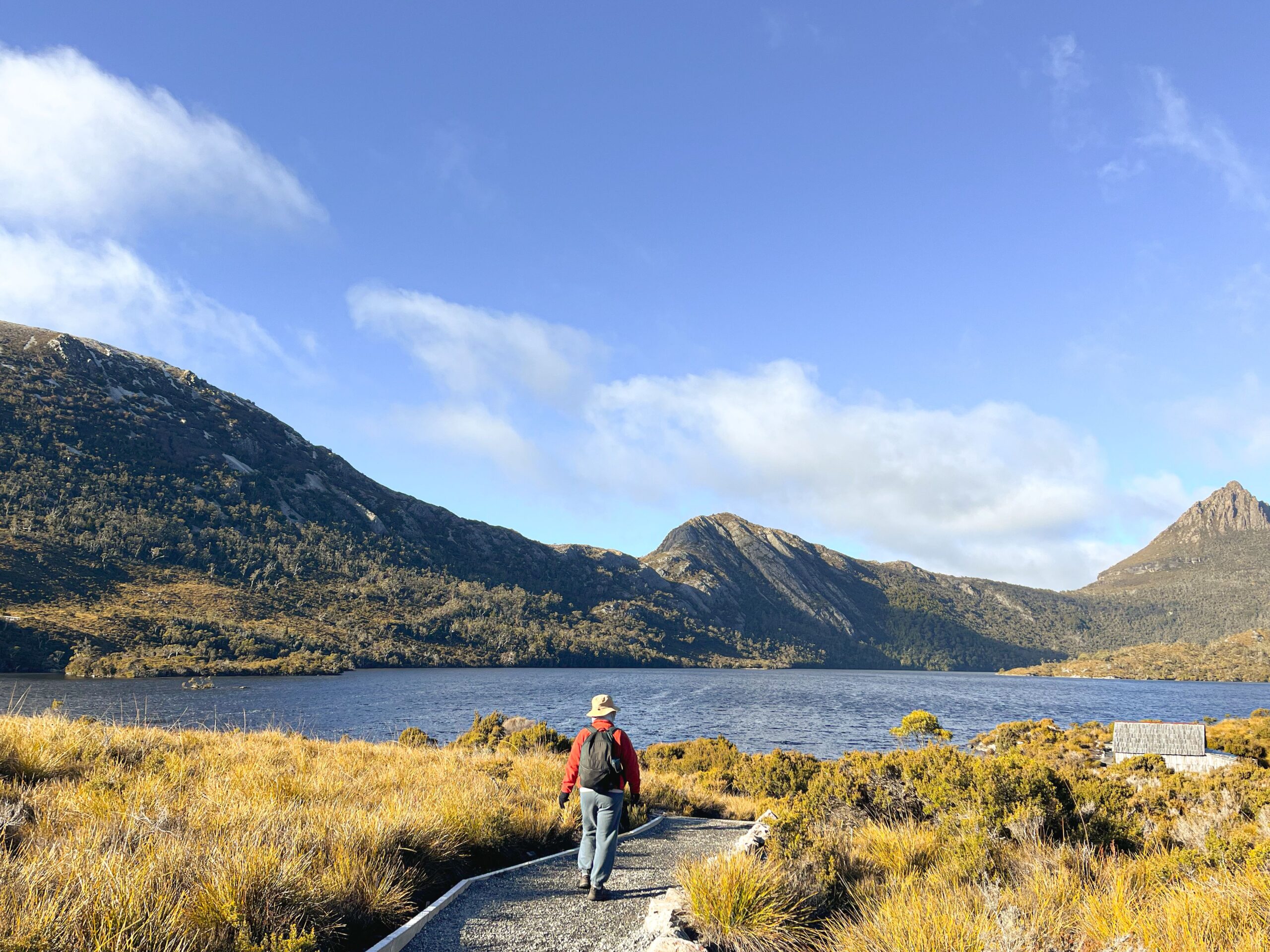
Dove Lake Circuit, Tasmania
Sitting beneath Cradle Mountain, Dove Lake provides some of Tasmania’s most recognisable alpine scenery.
Distance: Approximately 6 kilometres
Difficulty: Moderate
Why we like it: Spectacular mountain scenery without having to attempt the Cradle Mountain summit.
Tasmanian alpine weather can change quickly, so carry appropriate clothing even when conditions look good at the start.
Cape Hauy, Tasmania
Cape Hauy provides dramatic views across the Tasman Peninsula.
But this is where we move firmly away from the easier walks in this guide.
Distance: Approximately 10 kilometres return
Difficulty: Challenging
There are significant numbers of steps and demanding sections.
This is better suited to experienced walkers with good fitness rather than being presented as a general walk for people over 60.
If you are physically prepared for it, however, the coastal scenery is spectacular.
Great Ocean Walk, Victoria
You do not have to walk the entire Great Ocean Walk.
That is one of its biggest advantages.
Different sections allow you to experience the Victorian coastline without committing to a multi day trek.
Distance: Depends on the section chosen
Difficulty: Varies considerably
Why we like it: You can choose a section appropriate for your ability and still experience some of Australia’s most impressive coastal scenery.
Research the exact section before setting out because terrain and difficulty vary along the route.
Blue Mountains, New South Wales
The Blue Mountains deserve a place here because there is no single walk you have to complete.
Around Wentworth Falls, Leura and Katoomba you can find everything from short lookout walks to much more demanding bushwalks.
That makes the region particularly good for groups or couples with different fitness levels.
Distance: Varies
Difficulty: Easy through to very challenging
Why we like it: You can choose the experience rather than forcing yourself onto one particular trail.
Check current NSW National Parks information before leaving because track closures and conditions can change.
You Do Not Need to Walk Far
One thing worth emphasising is that distance is not the measure of a good walk.
A beautiful two kilometre coastal walk that leaves you feeling great is better than struggling through ten kilometres because you think that is what hiking is supposed to look like.
Walking after 60 should help you keep doing more of what you enjoy.
It should not become a competition.
What Should You Take?
For an ordinary day walk, your exact gear will depend on the location, weather, distance and remoteness.
But some basics are worth considering.
Water
Sun protection
Appropriate footwear
Weather appropriate clothing
A charged phone
Food or snacks where appropriate
Basic first aid supplies
Navigation information
For more remote walks, your preparation needs to increase considerably.
A Few Useful Hiking Items
This is where I would add the Amazon monetisation.
Trekking Poles
Walking poles can provide another point of contact with the ground and can be useful on uneven tracks, climbs and descents.
If you like using poles, an adjustable pair that packs down easily is particularly convenient for travelling.
See trekking poles on Amazon Australia
Hiking Boots
Footwear should suit both your feet and the terrain you are walking on.
The important part is getting something comfortable, correctly fitted and appropriate for the track rather than simply buying the heaviest hiking boot you can find.
See hiking boots on Amazon Australia
Daypack
For longer walks, a comfortable daypack gives you somewhere to carry water, food, sun protection, extra clothing and basic emergency supplies.
See hiking daypacks on Amazon Australia
Water Bottle
Carrying enough water becomes particularly important in Australia’s warmer conditions.
See insulated water bottles on Amazon Australia
Sun Hat
Sun protection deserves a permanent place in your walking kit.
See hiking sun hats on Amazon Australia
Small First Aid Kit
A compact first aid kit can be useful for minor cuts, blisters and other problems while away from immediate facilities.
See compact first aid kits on Amazon Australia
As an Amazon Associate I earn from qualifying purchases.
I would stop there.
Six Amazon links is plenty. Your separate hiking gear article should remain the page where someone looking to buy equipment gets the full commercial treatment.
Then add:
Want a more complete packing list? We have put together a separate guide covering the hiking gear worth considering after 60.
Hiking in Remote Areas
The further you move away from towns and mobile reception, the more seriously you should take emergency preparation.
Tell someone where you are going and when you expect to return.
Check weather and track conditions before leaving.
Know whether mobile reception is available.
And for remote bushwalking, consider carrying an appropriate emergency communication device.
We have a separate guide explaining Personal Locator Beacons and when they are worth carrying:
Send me the exact PLB article URL and I will insert it here.
I am deliberately not guessing it.
Walking With Other People
If you are new to bushwalking, joining a local walking group can be a great way to build experience.
It gives you an opportunity to meet people who already know local tracks while adding a social side to walking.
You can look for bushwalking clubs, council walking groups and community groups in your area.
If social connection is part of the reason you want to get out more, you might also like:
Start With the Walk That Suits You
You do not need to conquer Australia’s hardest hiking trails to call yourself a walker.
Start with a distance you are comfortable with.
Build your fitness gradually.
Choose trails that genuinely interest you.
And stop occasionally to actually look at where you are.
Australia has thousands of kilometres of extraordinary walking tracks.
You have plenty of time to explore them.
What is the best walk you have done in Australia?